
Pulaski Projected Versus Actual Release
A projected date is a calculated estimate for a sentence. An actual release date records completed departure. Pulaski pretrial detainees ordinarily have no sentence-based date because a hearing and entered detention or pretrial-release order control what happens next. A county sentence is calculated by the jail from the judgment, custody credit, eligibility, and conduct. IDOC calculates a state term. Federal and immigration cases use their own systems.
Find Pulaski Projected Release Dates
First identify the custodian and sentence type. The same person can move from county custody to state or federal custody, changing the correct source.
- Read the Pulaski court case for the judgment, sentence, and jail credit.
- For a county term, ask the detention center how it applied credit and allowance.
- For a state term, use the IDOC offender search and match the IDOC number.
- Treat the displayed projected field as an estimate, not a completed release.
- Confirm the event through the jail timestamp or IDOC release record.
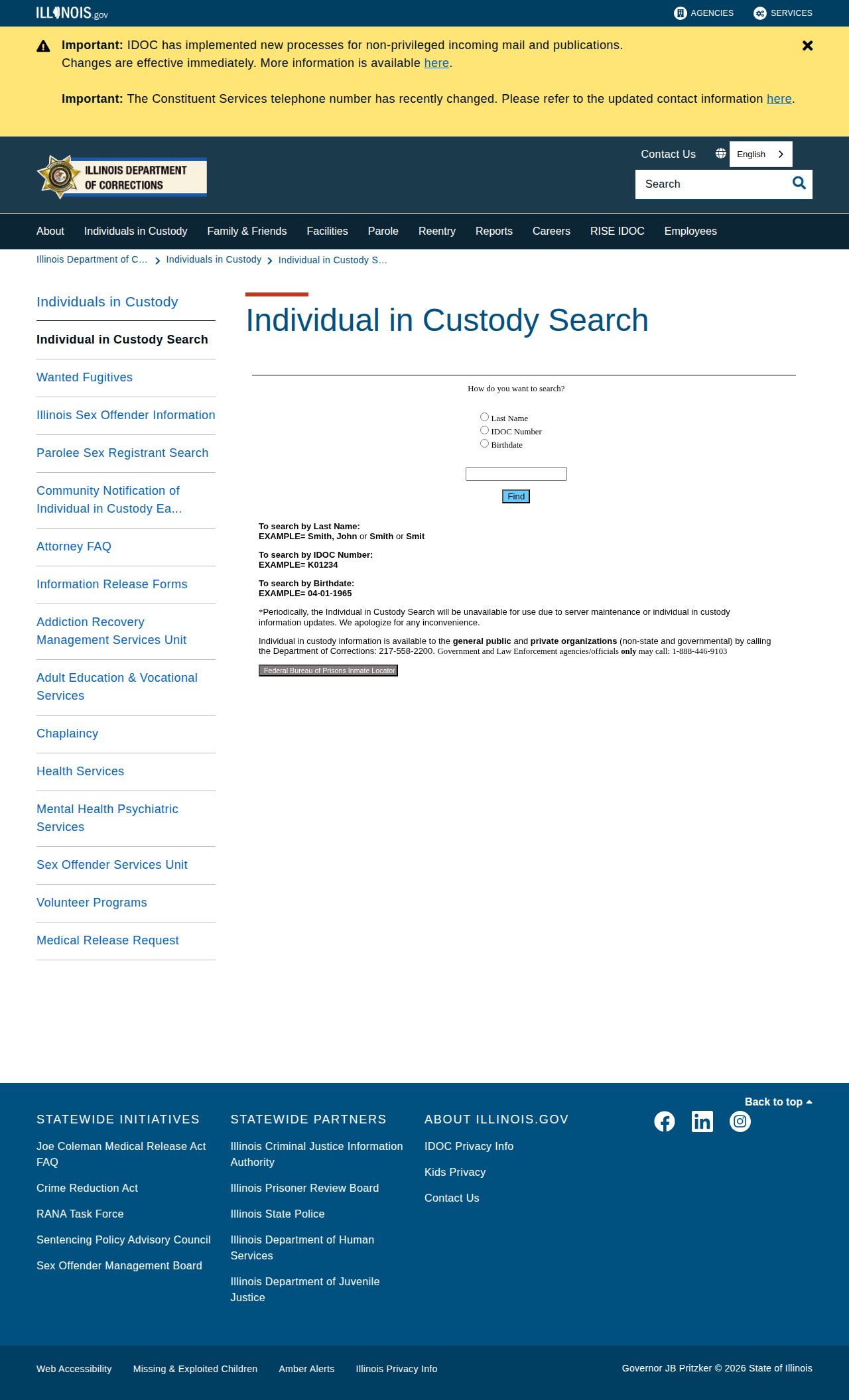
The official IDOC search provides the state entry point.
Illinois State Release Calculations
730 ILCS 5/3-6-3 is offense and date specific. Some determinate cases use one day of statutory credit per day served, often summarized as 50 percent. Enumerated groups can require about 75 or 85 percent, while first-degree murder and other listed categories may require 100 percent. There is no universal Illinois 85-percent rule.
Conviction, offense date, concurrent or consecutive structure, presentence credit, credit category, earned credit, discipline, absence, and court changes all matter. Earned Sentence Credit is discretionary and subject to eligibility, exclusions, and floors. IDOC cannot predict an award. When an award changes the projected date, IDOC says the profile is updated. Staff later verify the calculation, warrants, supervision term, identity materials, and release documents.
Why Pulaski Release Dates Change
A projection changes when the legal or custody inputs change.
| Factor | Possible effect |
|---|---|
| Court correction | Modifies or vacates the sentence. |
| Custody credit | Adds or corrects time already served. |
| Sentence credit | Award, restoration, or revocation moves the estimate. |
| Consecutive term | Requires aggregation with another sentence. |
| Warrant or detainer | Changes destination even if one term ends. |
| MSR revocation | Causes IDOC recalculation. |
Administrative review can also separate the legal date from physical processing. VINE may alert to the change, but the completed record confirms it.
County Jail Good Behavior
The County Jail Good Behavior Allowance Act can provide a qualifying person serving a fixed jail term one day of allowance for each day served. Eligible presentence time may count. Exclusions and mandatory-minimum limits apply, and discipline can revoke allowance under section 3.1. Restoration is possible. Day-for-day treatment can make an eligible term roughly half in custody, but it is never a universal promise.
Periodic imprisonment permits recurring periods outside custody under a court-authorized schedule. It is not final discharge. No statewide law was found that automatically moves every weekend or holiday release to Friday. Ask Pulaski how the named sentence is calculated and when processing will occur.
No Universal Pulaski Release Formula
County allowance and IDOC sentence credit are separate systems. Applying one percentage to every Pulaski case can produce a serious error. Read the judgment and the version of the governing statute tied to the offense date. Then confirm actual completion with the Pulaski release timestamp or IDOC face-sheet date and type.
A warrant, detainer, neighboring-county sentence, or USMS order can also mean the person leaves one facility but remains confined. Destination is therefore as important as date.
Pulaski Custody Determines the Date
A Pulaski court case can pass through several systems. A pretrial detainee has no sentence-completion date because release depends on the active court order, dismissal, or later judgment. A person serving a county term may have a local calculation. A defendant committed to IDOC has a state calculation, and a person held for the U.S. Marshals Service remains on a federal path.
| Situation | Best date source | What to verify |
|---|---|---|
| Pretrial Pulaski case | Circuit Clerk and detention center | Current order and actual jail processing |
| County-jail sentence | Jail record and judgment | Sentence, custody credit, allowance, holds |
| IDOC sentence | IDOC search and master file | State calculation and date/type of release |
| Federal custody | Federal docket, USMS, or BOP | Federal order, transfer, or BOP release date |
The Pulaski detention center houses local, neighboring-county, and USMS prisoners. A projected date from one case does not cancel another authority's lawful hold. Ask who committed the person and where the person will go next.
IDOC Pulaski Release Date Records
The public IDOC search accepts a partial last name, IDOC number, or birth date. Match the IDOC number before reading a result. The search is most useful while a person is incarcerated or on parole, and IDOC warns that fully discharged people may no longer appear. It is not a permanent archive of every Pulaski defendant who completed state custody.
IDOC master-file directives identify the deeper records behind a calculation: sentence calculations, release checklist and date notice, warrants and detainers, intended residence, identity material, status changes, parole packet, and the face-sheet date and type of release. If the web result has vanished or a displayed detail appears wrong, request the narrow release and discharge record instead of inferring an outcome from absence.
The IDOC FOIA page accepts online, email, fax, and mail requests. Name the person and IDOC number, state the exact date or record sought, and ask for electronic delivery. Illinois generally sets a five-business-day response framework for noncommercial requests, subject to a written statutory extension and applicable exemptions.
Note: A public search disappearance can follow full discharge; it does not supply the missing release date or type.
Reconcile Pulaski Court and Jail Dates
The Pulaski Circuit Clerk file establishes the legal basis for confinement and release. It may contain the charge, pretrial order, dismissal, sentence, custody credit, or later modification. The detention-center record establishes when staff completed a release or transfer. Those times need not match.
The official Pulaski sheriff page also directs court-record users to Judici. Use the court file for the legal order and the jail record for the completed custody event.
For a county sentence, request the booking number, admission date, actual release date and time, release type, releasing authority, and destination. Include the court case number and ask for the existing release screen, face sheet, or log entry. The jail FOIA route is separate from the Sheriff's general records route and is the more direct source for detention-center calculations.
A sentence end can still lead to another custodian. Pulaski's regional and federal housing roles make destination a core part of confirmation. A transfer to IDOC, another county, USMS, BOP, or immigration custody is not a community release, even if the local booking closes on the projected day.
Confirm the Pulaski Actual Release
Once the projected day arrives, look for an implemented custody event. For a local case, ask Pulaski County Detention Center for the actual timestamp and release type. For a state case, compare the IDOC status with the face-sheet release date and type. For a federal case, use the federal docket or BOP locator as appropriate.
VINE can send a release or transfer alert, but it is a lead rather than the certified endpoint. Its documentation does not promise a permanent post-release result or one fixed date label. The Pulaski VINELink inmate search guide explains how to preserve and verify an alert without confusing transfer with community release.
Track Pulaski Date Recalculations
A projected date should be checked again after any new judgment, sentence modification, credit decision, disciplinary action, warrant, or detainer. The governing version of a sentence-credit statute may depend on the offense and offense date. A court order can change the legal basis, while the custodian still needs time to review the file and implement the result.
For IDOC cases, the pre-release review includes sentence-calculation verification, a warrant check, release checklist, intended-residence information, identity material, and status-change records. That process is one reason the web field should not be read as a promise of a specific departure hour. If the calculation appears wrong, provide the IDOC number and case documents to the actual state custodian.
For a Pulaski county term, ask how custody credit and the county-jail allowance were applied to that sentence. Do not import an IDOC percentage into the local calculation. Once the person leaves Ullin, verify whether the destination was the community, IDOC, a neighboring county, or federal custody.