
Pulaski Probation Versus Parole
Probation is a sentence or disposition served in the community under the First Judicial Circuit’s court-services system. It can follow a conviction without a state-prison term, and local court records are the starting point. Parole and mandatory supervised release, often shortened to MSR, follow IDOC custody and are supervised by the Illinois Department of Corrections Parole Division. The Illinois Prisoner Review Board sets conditions and handles defined hearings, but it is not Pulaski County’s probation office.
| Record question | Probation | Parole or MSR |
|---|---|---|
| Who orders or controls it? | The sentencing court orders probation. | Illinois law and the sentence control release; PRB sets conditions and handles specified decisions. |
| Who supervises? | First Judicial Circuit court services in Pulaski County. | IDOC Parole Division. |
| Where to verify? | Pulaski court file and local probation office. | IDOC search while on supervision, then IDOC records if fully discharged. |
| How does it end? | Court completion or discharge shown in the case and probation record. | Final discharge recorded by IDOC and, where applicable, acted on by PRB. |
A person can leave the Pulaski County Detention Center without entering either system. Pretrial release means the case is pending in the community. Dismissal can end the detention basis. A transfer to IDOC is continued custody, not parole. Read the specific order and release record before assigning a supervision label.
- Probation
- A court-ordered community sentence managed through court services.
- Parole
- Community supervision associated mainly with older indeterminate Illinois sentences and specialized statutory processes.
- Mandatory supervised release
- Community supervision that normally follows the prison portion of a post-1978 determinate IDOC sentence.
- Discharge
- The formal end of the supervision term, distinct from the earlier physical release.
- Absconder
- A person alleged to have stopped reporting or left supervision without authorization; the label should be confirmed by the supervising authority.
Verify Pulaski Supervision Status
Start with the sentence type, not a broad name search. Pulaski probation and state supervision use different agencies, and fully discharged people may no longer appear in the IDOC public tool. A careful check joins the court record, the custody endpoint, and the current supervising authority.
- Find the Pulaski criminal case and match the person by case number and identifying details. Read the judgment, sentence, probation entry, and later violation or discharge entries.
- If probation was ordered, contact Pulaski County Probation with the case number. Staff disclosure may be limited, so request the proper court record when formal proof is needed.
- If the person received an IDOC sentence, search the official IDOC Individual in Custody Search by partial last name, IDOC number, or birthdate.
- Read the result’s current status and agency context. A parole result supports release from prison into supervision, but a missing result does not prove final discharge.
- For a person no longer returned by the public search, ask IDOC for the face-sheet date and type of release plus discharge date or status.
- Check PRB schedules or results only when the sentence or proceeding actually falls within the Board’s hearing work.
The Pulaski County released inmate search helps identify whether the last custodian was the county jail, IDOC, or a federal authority. That custody classification should come before any supervision conclusion.
Pulaski Probation Office Records
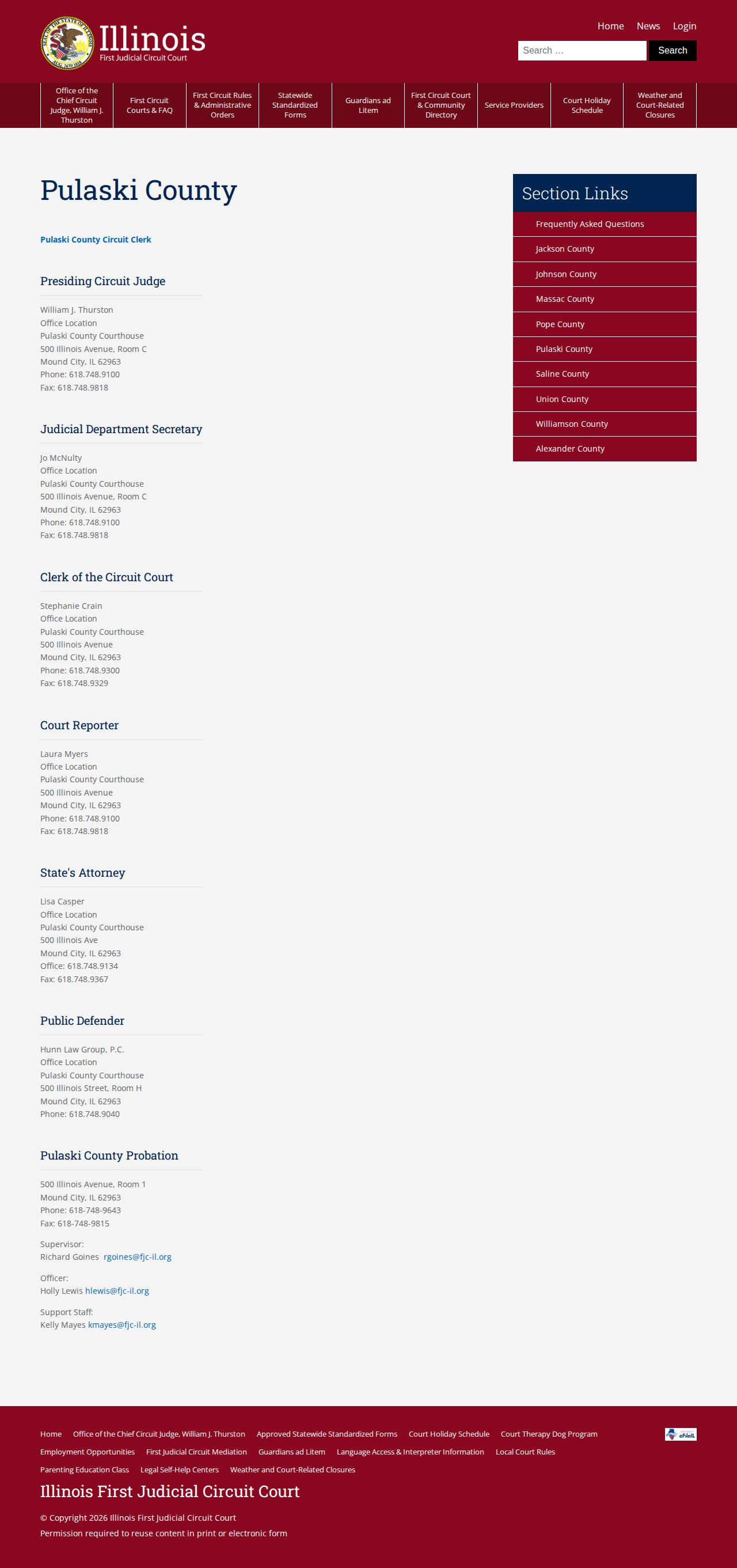
Pulaski County Probation is part of the First Judicial Circuit. It handles court-ordered probation, not IDOC parole or MSR. The local office is the best routing point for a current Pulaski probation question once the correct case number is known. Staff names can change, so durable verification should rely on the office and official circuit listing.
Pulaski County Probation500 Illinois Avenue, Room 1
Mound City, IL 62963
Phone: 618-748-9643
Fax: 618-748-9815
The First Judicial Circuit Pulaski County page is the source for the local probation contact.
Use the court file to establish the probation order and later docket activity. The office may confirm the correct process for a current-status or records question, subject to legal access limits. A court docket that shows probation was imposed does not always show every later report, compliance event, or confidential assessment.
Note: Pulaski County Probation does not supervise a person released from IDOC onto parole or mandatory supervised release.
Pulaski Parole and MSR Records
IDOC’s public search expressly covers people currently incarcerated or on parole. In Illinois usage, that public “parole” coverage can include post-prison community supervision. Search by last name, IDOC number, or birthdate. Match the record carefully, then read the status instead of assuming that any result means the person remains in prison.
A record showing parole or community supervision supports the fact that prison custody ended and IDOC supervision continues. The tool is not promised as a permanent archive. After final discharge, the former supervisee may stop appearing. No result can also reflect spelling, a data interruption, lack of IDOC custody, or another system.
For the durable record, contact IDOC public information at 217-558-2200 or submit a focused FOIA request to DOC.FOIARequest@illinois.gov. Ask for admission and release data, date and type of release, and the discharge date or status. IDOC’s record directives support these categories, although exemptions and redactions can apply. The Pulaski court judgment supplies sentence context; the state face sheet and field-service records supply execution and discharge.
IDOC’s parole page identifies the state supervision framework.
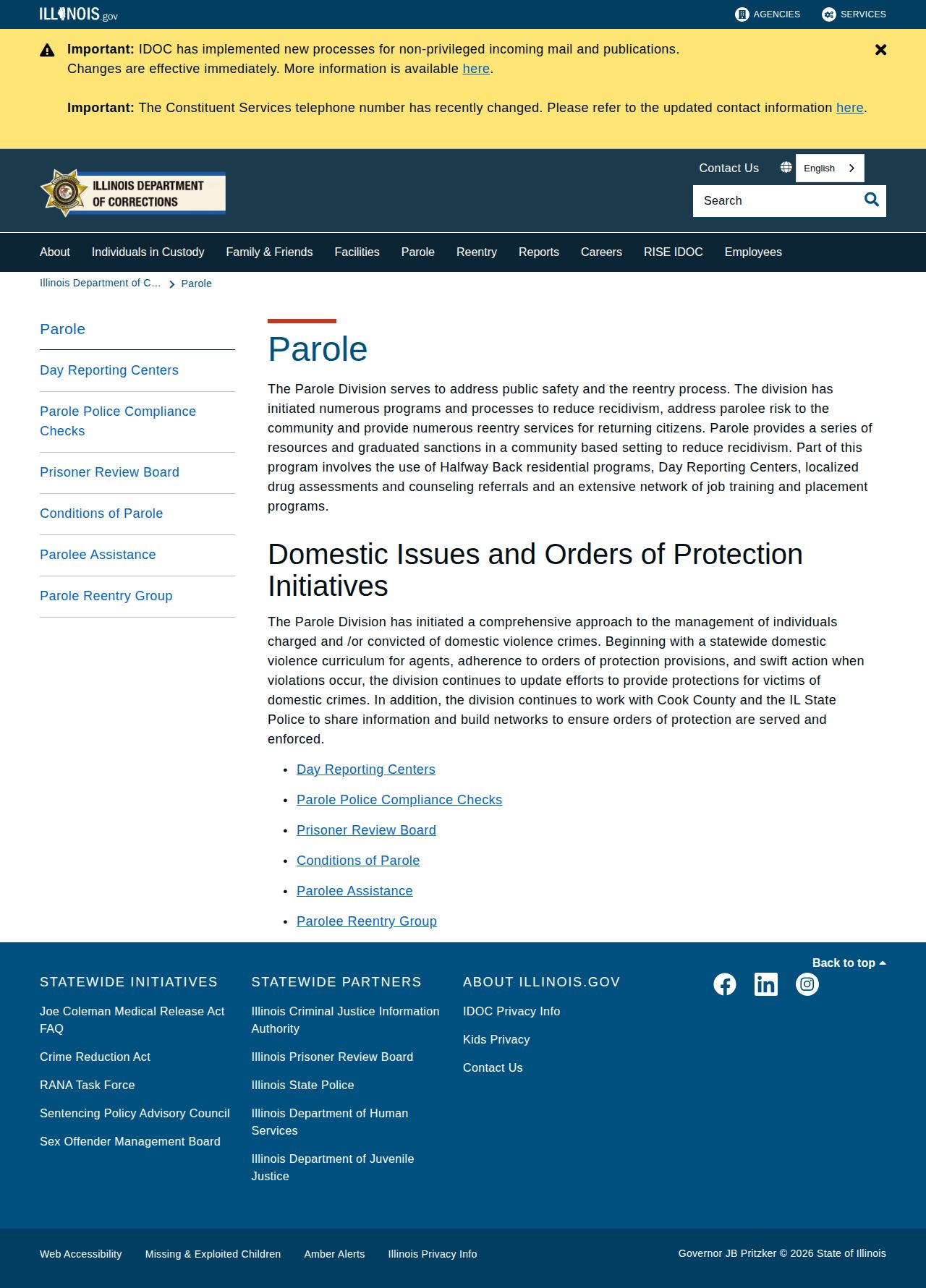
The state page should be used for IDOC supervision, not for a Pulaski probation sentence or a county-jail pretrial release.
Pulaski Parole Hearing Context
The Illinois Prisoner Review Board has several roles, and ordinary determinate MSR should not be mistaken for a discretionary parole grant. For most post-1978 determinate cases, release follows service of the term required by law. IDOC calculates the date, while PRB sets supervision conditions and conducts revocation and other specified proceedings.
Traditional indeterminate parole hearings concern older range sentences. PRB also conducts eligible youthful-parole, revocation, early final-discharge, medical-release, and clemency proceedings. For an indeterminate case, the Board meets en banc monthly and publishes annual dates, current results, past granted paroles, and minutes. A scheduled hearing is not a release decision.
| PRB source | What it shows |
|---|---|
| Yearly en-banc schedule | Published monthly meeting dates, not grants. |
| Current en-banc results | Current decisions for the cases listed. |
| Past paroles registry | Historical granted indeterminate cases. |
| Revocation schedules and results | Proceedings and outcomes tied to alleged parole or MSR violations. |
Supported indeterminate outcomes include granted, denied, and denied with a later reset. Revocation results can return a person to supervision, find no violation, add conditions, or revoke supervision and require IDOC recalculation. Only the applicable result and later IDOC record establish what happened in a named case.
Pulaski Supervision Conditions
Conditions differ by sentence, order, assessed needs, and PRB action. High-level parole or MSR conditions can address reporting, approved residence, travel, lawful conduct, treatment, and special restrictions. Probation conditions come from the Pulaski court order and the court-services process. A generic list cannot establish one person’s duties.
Use the signed probation order for a Pulaski probation case. For parole or MSR, use the conditions issued through the state process. Do not infer a condition from an offense label or another person’s record. Some records may be restricted because they contain medical, treatment, victim, residence, security, or other protected information.
Illinois VINE is a custody and case-notification system, not a full supervision-condition database. It can notify registered users of release, transfer, escape, and other custody changes where participating data exists. A VINE notice may help mark the move out of custody, but it does not replace the probation order, PRB conditions, or IDOC discharge record.
Pulaski Absconder and Warrant Checks
No official statewide public list of every Illinois parolee, MSR supervisee, absconder, or supervision warrant was located. IDOC has a narrow search involving parolee sex registrants, but that offense-specific tool is not a general parole lookup. A missing public result must not be treated as proof that no warrant or violation exists.
For probation, inspect the Pulaski court docket for a petition to revoke, warrant entry, hearing, order, or discharge. Then contact the local probation office through the official case route. For parole or MSR, contact IDOC and review any applicable PRB revocation schedule or result. Warrant and absconder details may remain in internal law-enforcement and master-file systems.
An allegation is not the same as a final finding. PRB revocation proceedings can produce several outcomes, including resumed supervision or revocation. Read the actual result and later IDOC status. If immediate safety or surrender instructions are involved, use the responsible government or legal authority rather than acting on an unverified portal label.
Note: Offender registries cover only people with statutory registration duties and cannot verify Pulaski County probation or parole for the general public.
Correct Pulaski Release Records
IDOC’s release process includes a master-file review, sentence-calculation verification, warrant check, release checklist, intended-residence details, identity material, and status-change records. These source records matter when a public profile contains a wrong date, identity detail, or supervision status. A portal disappearance does not correct the underlying record.
Send the correction concern to the actual custodian and provide the IDOC number, case number, and supporting order or document. If the issue concerns Pulaski probation, start with the local court and probation record. If it concerns IDOC release, MSR, or discharge, use IDOC. PRB records are relevant when the Board made the specific decision at issue.
A narrow request is easier to evaluate than a broad demand for “everything.” Ask for the face-sheet date and type of release, discharge status and date, or the particular decision that conflicts with the portal. Request nonexempt portions if part of the file is withheld.
How Pulaski Supervision Ends
Probation ends through the court-supervision process reflected in the Pulaski case and probation record. The precise outcome can include successful completion, a court discharge, modification, or a violation proceeding. The docket should be read with the governing order because a sentence entry alone may not capture every later event.
Parole or MSR ends at final discharge. PRB can act on final discharge when case-specific legal standards are met, considering assessment information, compliance, program or treatment participation, case factors, and IDOC recommendations. Final discharge is not the same date as release from prison. Community supervision may continue after the custody endpoint.
Once final discharge occurs, IDOC’s public search may no longer return the person. Obtain the date and type of release plus the later discharge status from state records. That two-date history avoids a common error: calling the prison-release date the end of every correctional obligation.